
Pickup guides
How to Estimate Junk Volume in Cubic Yards
A cubic yard is the space inside a cube three feet on each side. You can use it to describe a pile without knowing the hauler’s truck size. Send that estimate with an item list to give the crew a useful starting point.
Measure the occupied space in feet
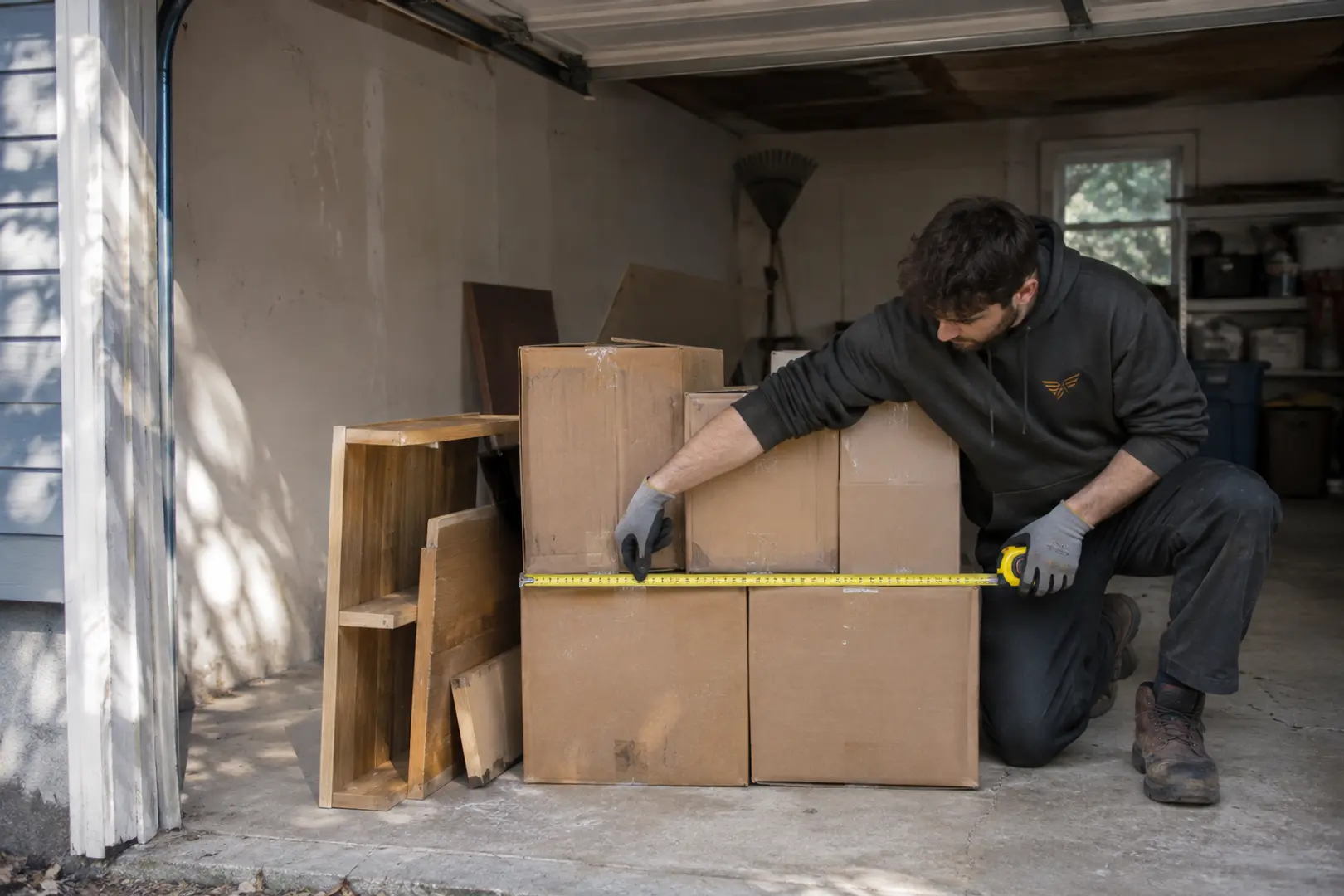
For a roughly rectangular stack, multiply length by width by height, all in feet. Divide the result by 27. A stack 6 feet long, 3 feet deep and 3 feet high occupies 54 cubic feet, or about 2 cubic yards. A tape measure and a photo will do. You don’t need to rebuild the pile into a perfect cube.
| Approximate stack | Cubic feet | Cubic yards |
|---|---|---|
| 3 ft × 3 ft × 3 ft | 27 | 1 |
| 6 ft × 3 ft × 3 ft | 54 | 2 |
| 9 ft × 4 ft × 3 ft | 108 | 4 |
Allow for the shape of the objects
A room with two bookcases on opposite walls doesn’t contain a roomful of junk. Measure the pieces or their separate stacks. Include shelves, cushions or detached legs that are coming too. Note whether chairs nest and whether flat-packed pieces can lie together.
For a sectional, an upright piano or a large appliance, the dimensions of the largest piece may be more useful than the volume calculation. A partially filled box still takes up its full outside dimensions unless someone repacks it. Two piles with the same dimensions can also have very different weights.
A mixed pile with two different heights
Imagine eight feet of wall lined with boxes. The first four feet are stacked two feet deep and three feet high, or 24 cubic feet. The other four feet are two feet deep and only one foot high, or eight cubic feet. Together that is 32 cubic feet. Divide by 27 for an estimate of about 1.2 cubic yards.
Measuring the whole pile at its tallest point would give you 48 cubic feet. Splitting it into two obvious blocks takes very little time and avoids counting air above the shorter boxes. If the tape reads 18 inches, use 1.5 feet in the calculation.
Use the estimate to ask a better question
The boxed items form a stack about six by three by three feet. There is also one assembled desk, 60 inches wide, and one chair. They’re on the second floor at the end of the hall.
That description gives the crew a usable volume, two exceptions and the start of a carry plan. If a quote is expressed as a fraction of a truck, ask how many cubic yards that truck holds and what else the estimate includes. For storage removal, send photos of stacked contents. For renovation material, describe weight and composition alongside the dimensions.
When to skip the arithmetic
For one couch, send the length, depth, height and whether the arms or chaise come off. For a dozen bags of tile, describe the number and approximate size of the bags and what is inside them. A cubic-yard total alone gives a poor picture of either job. Point out anything the crew will need to move past in order to reach the load.
Have a pickup in mind?
Tell us what’s going, where it sits and when you need the space.